
In healthcare, the pursuit of better patient outcomes is paramount. Quality improvement methodology provides a structured framework for achieving this. Integrating quality measurements allows healthcare teams to evaluate results and perform evidence-based improvements to ensure effective implementation of this methodology.
This article explores the definition, most common QI methodologies used in healthcare, and the best quality improvement methodology NHS follows.
What Is A Quality Improvement Methodology?
QI Methodology refers to structured and systematic approaches used to improve processes, systems, and outcomes within organizations. These methodologies, influenced by successful industrial practices, focus on:
- Identifying inefficiencies in systems or processes.
- Minimizing errors to improve safety.
- Improving quality to meet or exceed customer or stakeholder expectations.
These approaches, first developed in sectors like manufacturing, are now widely adopted in healthcare to improve systems and processes, aiming for better outcomes and higher-quality services.
If you’re a healthcare facility owner looking to enhance your processes and outcomes, consider partnering with us to implement effective quality improvement solutions tailored to your needs.
The Most Common QI Methodologies Used In Healthcare
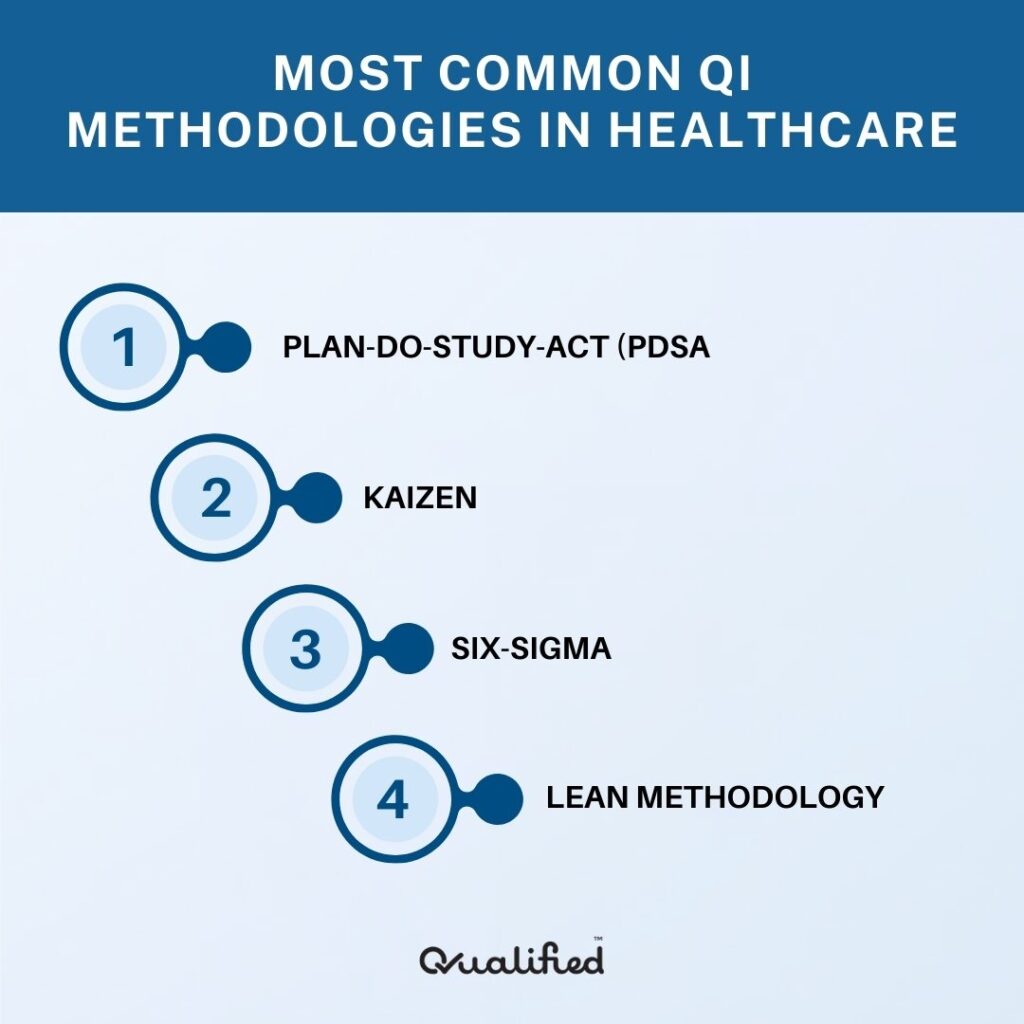
There are several QI methodologies used in the healthcare sector, which focus on enhancing efficiency, reducing waste, and improving patient outcomes. Let’s explore the most commonly used ones in healthcare:
1. Plan-Do-Study-Act (PDSA)
The Plan-Do-Study-Act (PDSA) cycle is a four-step iterative process designed to test and implement changes that enhance system quality. Although healthcare improvement widely recognizes this method, comprehensive evaluations of its implementation remain limited.
The process begins with planning a change, followed by conducting a small-scale test (Do). Next, teams assess the results (Study) and use the findings to make necessary adjustments for the next cycle (Act). By repeating this process, ideas are refined, their effectiveness is tested, and healthcare practices are continuously improved. Each cycle builds upon the previous one, fostering ongoing learning and adaptation.
2. Kaizen
The Japanese philosophy of Kaizen focuses on continuous improvement. The goal is to reduce waste and maximize value-generating activities.
Healthcare Kaizen is a quality improvement methodology focusing on implementing small, continuous improvements to enhance efficiency, quality, safety, and workplace culture over time. All employees, directors, nurses, doctors, and other staff actively participate by evaluating their daily routines and suggesting improvements, making their involvement essential to the methodology’s success.
3. Six-sigma
Six Sigma identifies the underlying causes of variation, to comprehend and reduce them, using statistical methods and a robust framework DMAIC (Define, Measure, Analyze, Improve, Control). It’s about executing things correctly, without any flaws.
Applying this framework in healthcare can improve patient outcomes, increase productivity, and reduce healthcare expenses.
4. Lean Methodology
This is an approach that aims to reduce waste and enhance value stream flow. It’s all about moving fast.
In healthcare, it can improve operational performance and patient care by optimizing operations, cutting out pointless stages, and minimizing delays. Lean seeks to improve the overall quality of care and the patient experience by providing patients with the most value while using fewer resources.
Every healthcare system chooses the most suitable QI methodology based on its specific needs, goals, and resources. Healthcare professionals interested in advancing their knowledge of these methodologies can participate in various medical courses and webinars designed to enhance their skills and understanding.
Best Quality Improvement Methodology NHS Follows
The National Health Service (NHS) is at the heart of healthcare in the UK, trusted by millions to deliver safe, effective, and compassionate care. Given the complexity of healthcare delivery and the need for continuous improvement, the NHS prioritizes methodologies that enhance patient outcomes.
The quality improvement methodology NHS follows is the PDSA cycle. It’s a practical, hands-on approach that helps teams test new ideas, learn from the results, and make meaningful changes. In addition, it’s flexible, focused on real-world outcomes, and keeps patients at the center of every improvement effort.
Measurement As An Integration To QI
Quality measurement is considered an integration of QI. It plays a vital role in QI by providing a clear understanding of performance, identifying areas needing enhancement, and evaluating the effectiveness of interventions.
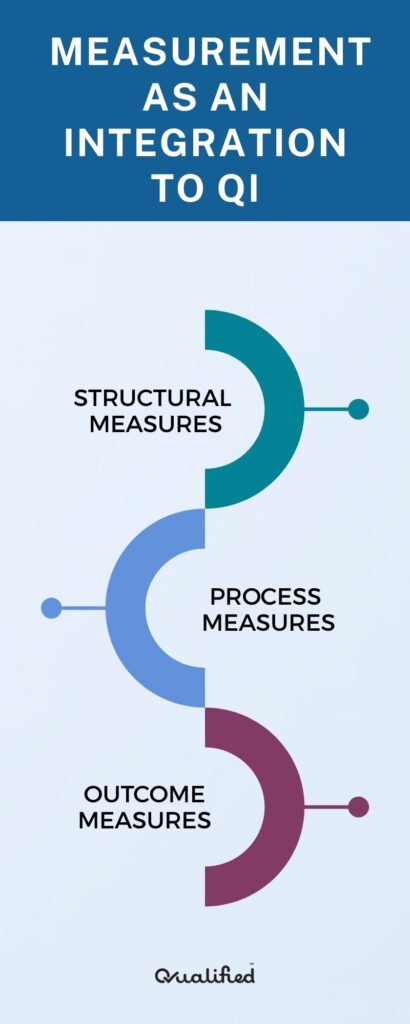
Healthcare quality measures are categorized into three types:
1. Structural Measures
They provide insight into a healthcare provider’s capacity, systems, and infrastructure to deliver high-quality care. Examples include:
- The percentage of board-certified physicians.
- The providers-to-patients ratio.
2. Process Measures
These measures reflect the actions healthcare providers take to maintain or improve health, whether for healthy individuals or those with specific conditions. Examples:
- The percentage of individuals receiving preventive services, such as immunizations.
- The percentage of diabetic patients whose HA1C was measured twice in the past year.
3. Outcome Measures
Their role is to evaluate the impact of healthcare services or interventions on patients’ health status. For example:
- The rate of surgical complications or hospital-acquired infections.
- Surgical mortality rates.
While outcome measures are often considered the “gold standard” for assessing quality, they are influenced by numerous factors, many of which are beyond a provider’s control.
Conclusion
PDSA methodology remains widely utilized in the healthcare sector. It’s the quality improvement methodology NHS follows to drive systematic improvements. Ensuring its consistent and effective application is essential to maximize its potential.
Quality measurement is no less important. It integrates QI efforts, enabling continuous assessment, refining processes, and driving data-informed decisions to enhance patient care and outcomes. As a healthcare institution, implementing QI methodologies and measurements makes your services unique!
Know more about quality improvement through our interesting medical articles.